
Opted Out, Yet Tracked: Are Regulations Enough to Protect Your Privacy?
Zengrui Liu, Umar Iqbal and Nitesh Saxena
Privacy Enhancing Technologies Symposium (PETS)/Proceedings on Privacy Enhancing Technologies (PoPETs). July 2024.
[pdf]
News
Paper accepted to CNS 2023
- Speaker Anonymity and Voice Conversion Vulnerability: A Speaker Recognition Analysis
Shalini Saini, Nitesh Saxena.
In Conference on Communications and Network Security (CNS), October 2023.
Paper accepted to MobiCom 2023
- Breaking Mobile Notification-based Authentication with Concurrent Attacks Outside of Mobile Devices
Tanvir Ahmed Mahdad, Mohammed Jubir and Nitesh Saxena
In the 29th Annual International Conference on Mobile Computing and Networking (Mobicom), October 2023.
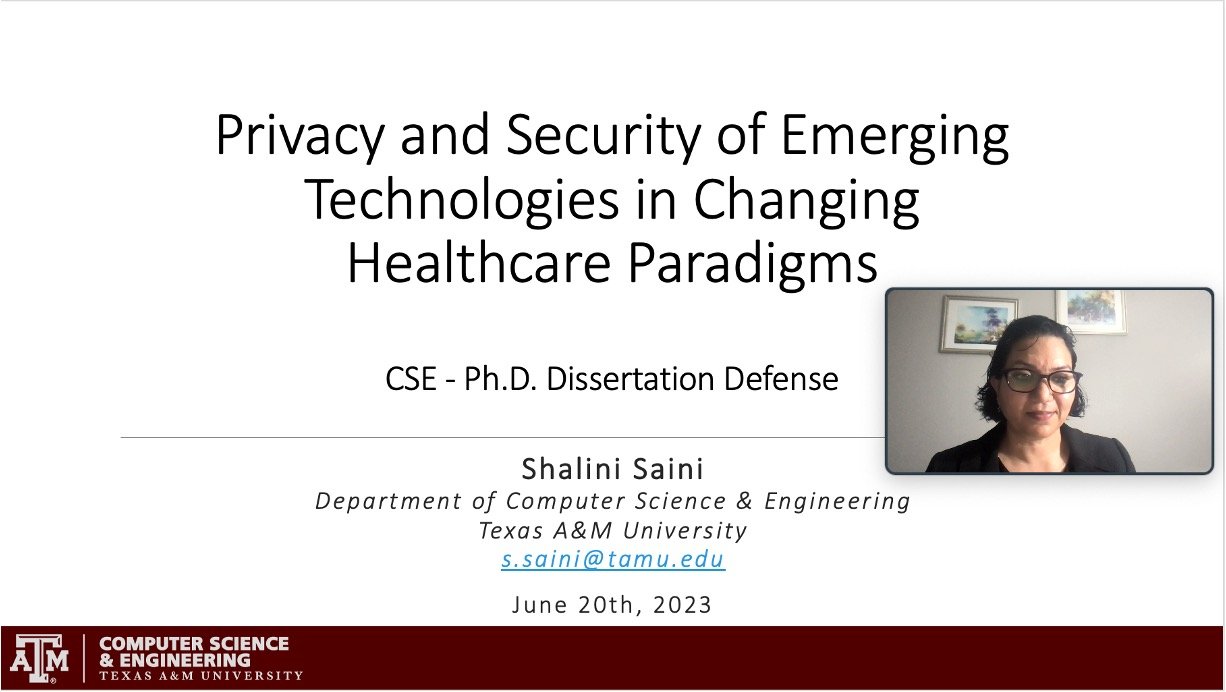
Presenting SPIES’ 13th PhD Graduate — Shalini Saini
Presenting SPIES Lab‘s 13th PhD graduate (5th woman PhD graduate), Shalini Saini. Shalini did some really important work in the domain of S&P of healthcare tech: medical AI, mobile apps (including reproductive health apps in light of Roe vs. Wade overturn) and voice privacy.
Many congratulations!
Dr. Saxena appointed as Associate Director of Cybersecurity Institute
Dr. Saxena has been appointed as the Associate Director of the Texas A&M Global Cyber Research Institute (GCRI). Among other things, in this role, Dr. Saxena will be leading the Institute’s cross-disciplinary research programs pertaining to cybersecurity.
The Texas A&M Global Cyber Research Institute (GCRI) endowed by Ray Rothrock ’77 and Anthony Wood ’90 was created in 2021 to elevate Texas A&M’s efforts in the broad information security area. The institute is jointly administered by Texas A&M University and the Texas A&M Engineering Experiment Station (TEES) and it will assist in engagement and coordination of information security and cyber defense programs within TEES and Texas A&M University colleges, institutes and centers.
Saxena and team awarded $6M DOD grant on cognitive security
https://engineering.tamu.edu/news/2023/04/saxena-awarded-12m-grant-to-study-cognitive-security.html

Cognitive security refers to the notion of protecting people from information-based threats that aim to disrupt cognitive processes, such as reasoning and decision-making. | Image: Getty Images
Dr. Nitesh Saxena, professor in the Department of Computer Science at Texas A&M University and Engineering Dean’s Research Fellow, is part of a research team that was recently awarded a $6.2 million grant from the highly competitive Department of Defense’s Multidisciplinary University Research Initiative (MURI) Program. Given over five years, the funds will support their work investigating human cognitive security in various information environments.
Collaborators on the project include researchers from the United States Air Force Academy and the University of Colorado Boulder. Saxena is the sole Texas A&M principal investigator, and the university will receive $1.2 million from the grant.
Cognitive security refers to the notion of protecting people from information-based threats that aim to disrupt cognitive processes, such as their ability to reason and make decisions. Due to the prevalence of sophisticated technology, social media, the amount of personal data generated online daily in society and the convergence of information technology with operational technology, these threats are becoming increasingly more dangerous in scale and scope.
The researchers will develop defensive solutions to combat users’ susceptibility to cyber-attacks through the foundations of psychology and neuroscience for their project. To do this, the team will study average users, emergency responders and astronauts within various information-dense environments that may impact their decision-making when faced with security threats.
“This is an area of research that was pioneered in my lab and that of my collaborators. We are humbled to receive the award and excited to launch this MURI project to further contribute toward a deeper understanding of human behavior vis-à-vis cybersecurity threats and design appropriate mitigations,” Saxena said.
The team’s previous studies on user-centered security regarding how people process the tasks of detecting phishing attacks and malware warnings serve as a foundation for this project.
A total of 31 teams from 61 U.S. universities were selected to receive a MURI grant to support their research projects, which span 24 topic areas that are of strategic importance to the Department of Defense.
Dr. Saxena appointed as the Vice Chair of EFAC
Dr. Saxena has been appointed as the Vice Chair of the Engineering Faculty Advisory Council (EFAC), 2023-2024.
https://engineering.tamu.edu/information/efac/index.html
The purpose of the Engineering Faculty Advisory Council (EFAC) is to:
- Generate and develop broad ideas for the improvement and ultimate development of the Texas A&M University College of Engineering and to suggest policies that will enable the College of Engineering to better serve the educational needs of the people of Texas.
- Advise the dean of engineering on matters of basic importance to the engineering faculty as a body.
The committee includes a faculty member from each of the departments in the College of Engineering. The representative is elected by their department’s faculty every three years. EFAC meets with the dean once per month during the academic year. Each representative serves as a liaison between his/her department’s faculty and the committee, and is responsible for conveying concerns and suggestions to the committee, which in turn discusses these issues with the dean. Our faculty are welcome to attend EFAC meetings, but must convey their concerns or suggestions through their department representative or the EFAC chairperson.
Paper accepted to MobiSys 2023
- Passive Vital Sign Monitoring via Facial Vibrations Leveraging AR/VR Headsets
Tianfang Zhang, Cong Shi, Payton Walker, Zhengkun Ye, Yan Wang, Nitesh Saxena, Yingying Chen
In the 21st ACM International Conference on Mobile Systems, Applications, and Services (MobiSys), June 2023
Paper accepted to ICDCS 2023
- EmoLeak: Smartphone Motions Reveal Emotions
Ahmed Tanvir Mahdad, Cong Shi, Zhengkun Ye, Tianming Zhao, Yan Wang, Yingying Chen and Nitesh Saxena
In the 43 rd IEEE International Conference on Distributed Computing Systems (ICDCS), July 2023.
Journal paper accepted to ACM Computing Surveys
- A Survey of Threats to Research Literature Dependent Medical AI Solutions
Shalini Saini and Nitesh Saxena
In ACM Computing Surveys (CSUR), 2023